A few hundred
trees.
A hazelnut tree wants mild winters, a long spring, and deep ground to sink a root into. It gets all three on this slope, which drops west toward the coast range in soil that is wet clay over basalt and smells like mowed grass nine months a year and like roasted nuts for three.
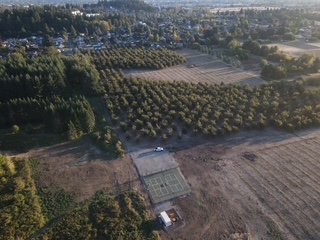
Planet Earth, lower-left quadrant.
The Willamette Valley grows about ninety-nine percent of the country’s hazelnuts. Most of the rest comes from Türkiye and Italy. Almost none from Mars. The valley has the right combination of mild winters, long springs, deep soil, and bored agronomists with old grants from the seventies.
The first trees here went in the ground in 1925. A hazelnut takes about eight years to bear a real crop and then keeps going for fifty, which is why a farm like this gets measured in generations — three of them, on the same ground, and counting.
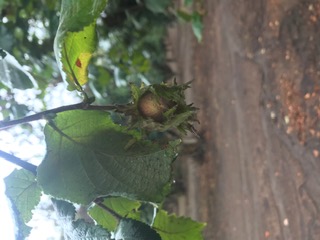
What hazelnut farming actually looks like.
Hazelnuts fall to the ground when they’re ripe. There is no ladder, no crew, no shaking. The trees drop them, the floor of the orchard turns brown with husks, and a low machine drives between the rows and sweeps them into windrows. Another machine picks the windrows up. They go to a drying shed for a week.
That’s the whole harvest, and it happens in October. The machines handle the main acres. The oldest trees — the 1925 block, a few hundred of them — we still gather by hand. Loud for about six days a year, silent for the other three hundred and fifty-nine.
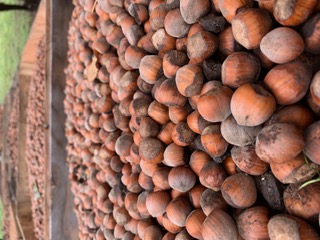
 Hazelnuts
 A nut by any other name.
Hazelnut, filbert, cobnut — the same nut answers to all three. It’s one of the richest tree nuts in vitamin E, and it turns sweeter the darker you roast it, right up until the second it turns bitter.
Raw, it tastes green and grassy. Roasted, it tastes like the inside of a chocolate bar. Salted, it goes by the handful. That last one is the problem.
The nuts are also for sale.
Five ways: raw in-shell, salted, dark roast, candied, and the gift box.
See the nuts →